
I once watched a parking attendant writing tickets and asked him, out of genuine curiosity: how are people supposed to know they are in a restricted zone? The nearest sign was more than 300 metres back, and depending on which direction you came from, you would miss it. You are in an unfamiliar area. You are watching traffic lights. You are checking your navigation to work out where you are supposed to be.
He shrugged and said: it’s fine. Once they get the ticket, next time they will remember.
That answer stayed with me, because it describes a set of levers we use in organisations too.
When it comes to change management, there is no shortage of ideas, models and theories. Pick your framework. But one thing holds true across all of them: when people are not truly on board, real change is very hard to get done. Targets may be reached. And still there can be that feeling that something is not quite right.
I have been trying to find a way to describe that gap, and the parking attendant kept coming back to me.
The blue disc and the missing sign
In Germany, you have a Parkscheibe, a small blue disc with a rotary dial that you set to your arrival time, rounded up to the next half hour. In many areas, a sign with that symbol tells you to put the disc in your car, and gives you a limit: one hour, two, or three hours, in most cases. In other parking zones the rule is different; you pay at a machine and display the ticket on the dashboard so it can be clearly seen through the windscreen.
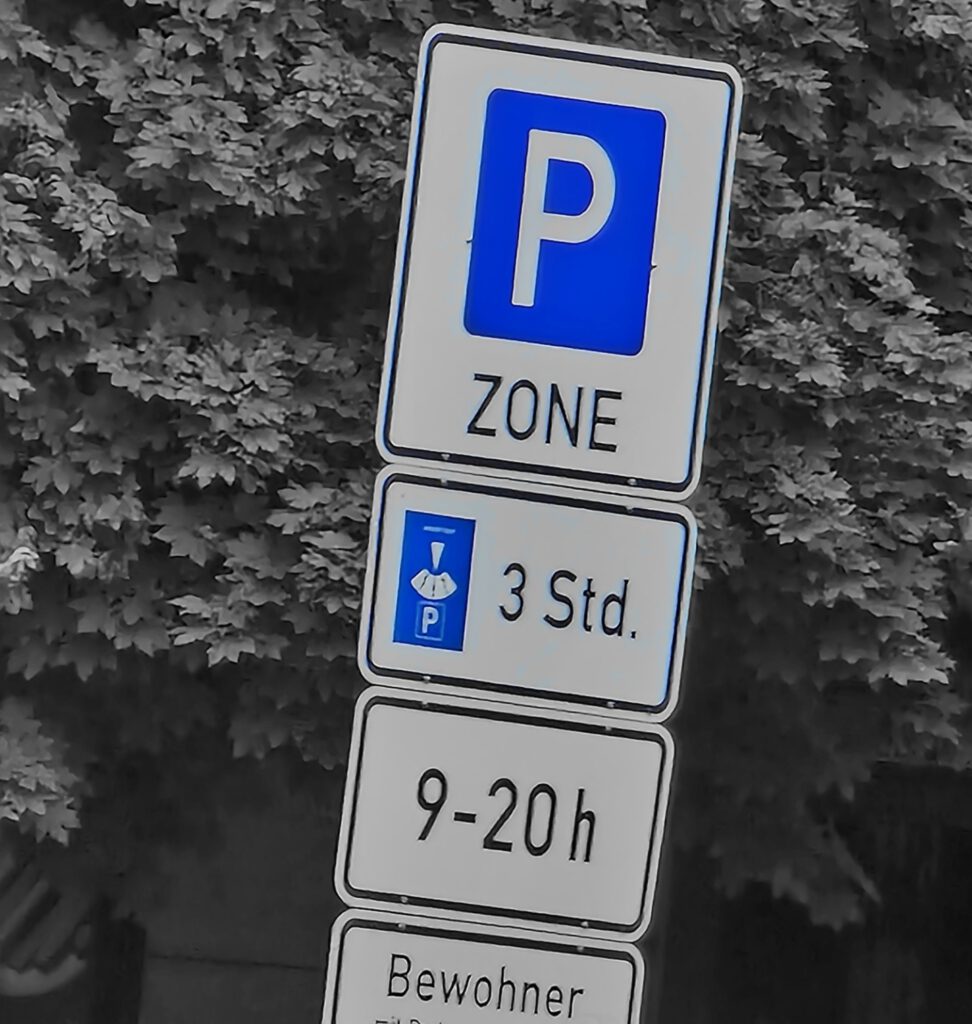
The point is that not every area requires the Parkscheibe. Outside a supermarket it is obvious enough; the shop wants to stop people occupying valuable customer parking spaces all day. But over time these systems moved into city centres, and then into residential neighbourhoods, where whole parking zones have been introduced, enforced either by the disc or residential parking permits.
Here is the design problem. A zone is marked at its entry points. As you turn into the street, or cross into the area, there is a sign. Once you are inside the zone, there may be no signs at all for several blocks or streets because the assumption is that at some point, when you entered the zone, you saw a parking zone sign.
A lot of people get tickets this way. They do not realise they are in a zone, especially in neighbourhoods. Which is how I came to be standing next to that attendant, asking my question.
The same levers, at work
We signpost at work, too. Rules are written down, regulations are shared, requirements are communicated. And we apply penalties: if you contravene the policy, say by putting client financial data where it should not be, there are consequences. Signage and sanctions. That is often the whole toolkit.
What both rely on is a quiet assumption: that because something was announced, it is understood. Awareness gets treated as though it were the same thing as understanding, and the penalty is left to do the teaching that the communication did not.
I found myself thinking about this again recently in the context of AI: getting people to actually adopt the mandated tools and processes. One question comes up more than any other. People say, okay, I hear what you are telling me about this tool or that process, but what are other people doing?
For a long time I wondered why that question, “what are other people doing?“, comes up so persistently. Why does it matter what everyone else does?
Checking the other windscreens
Then it happened to me. I was travelling with some colleagues and we were looking for parking in an area I did not know. My gut feeling, because of the restrictions where I live, was that there was probably a parking restriction rule here too. But I had not seen a sign. And unlike cities such as New York or London, there are no painted parking restriction lines on the road letting you know immediately what the requirements are. You rely entirely on signage, including temporary signs put up for roadworks or tree-surgery work, which you simply have to notice. If you miss it, as the parking attendant said, it is on you.
So I stood there, unsure whether to set my disc (which would also mean I have to be back in within three hours), or whether I needed to walk somewhere and pay. And then I thought: let me just look in the other windscreens.
None of them had a parking ticket. None had a neighbourhood parking permit. Fine, I thought. This must not be a restricted zone. I did nothing, and we went on with our day.
But it niggled. Later, walking back to the car, I was looking warily at the windscreen from a distance, and was quietly relieved to find no penalty ticket under the windscreen wiper. I never did find out for sure if it was a restricted parking area. I was simply glad that I got my desired result.
That tension is the thing worth paying attention to. With parking, I felt it twice: once when deciding whether to stop searching for a parking zone sign, and once when returning to the vehicle. In between, I was busy with other things and did not think about the car at all.
At work it is not like that. When you are using the tools you have been given, day in and day out, the same question surfaces again and again, all day long, in slightly different forms. Am I allowed to use this here? Is this the approved way? That lack of clarity has a cost, and it compounds. That cost can show up as hesitation, shadow tools, work not done, people quietly defaulting to the old way of doing things.
And when it surfaces, people do exactly what I did in that street. They look at the nearest windscreens: their team manager or the colleague next to them. Whatever those people are doing, they will do. So the honest thing to acknowledge is that peer behaviour moves adoption more reliably than policy does. Where the two disagree, peer behaviour usually wins.
Showing, not just telling
Which means it matters enormously that we understand what people are actually doing, what they are communicating to each other, and that we make that visible on purpose.
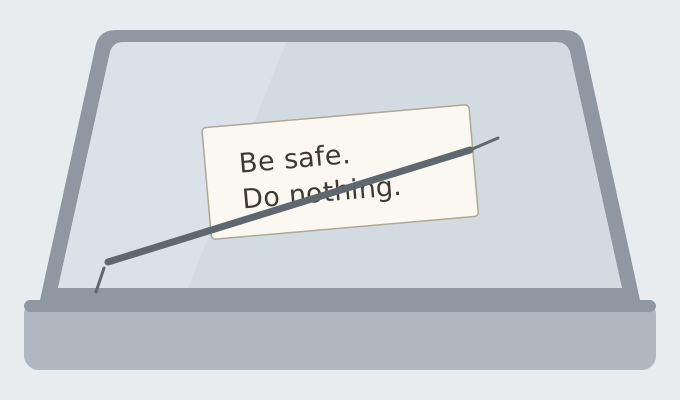
So one of the things I think we should be doing more of is showcasing. Not just announcing what is available, but showing what our teams genuinely use to get work done. If people are going to read the windscreens around them anyway, the work is to make sure there is something worthwhile to read.
The parking attendant was not wrong that a ticket teaches a lesson. He was wrong about what it teaches. A ticket teaches you to be wary. It teaches you that this is a place where you can be caught out, and that the safest thing is to move carefully and check what everyone else is doing. It does not teach you the rule, and it does not make you willing to experiment.
That is the part worth taking seriously as organisations move people into AI tools and new ways of working. If someone is unsure, they will look at the nearest windscreen. They will do that whether or not we have thought about it, and whatever the policy says. The only real question is whether we have put anything there worth reading.